How to Stop Slicing the Golf Ball
Fix your slice by learning how clubface and swing path create curve, then check your grip and aim and run three simple drills.
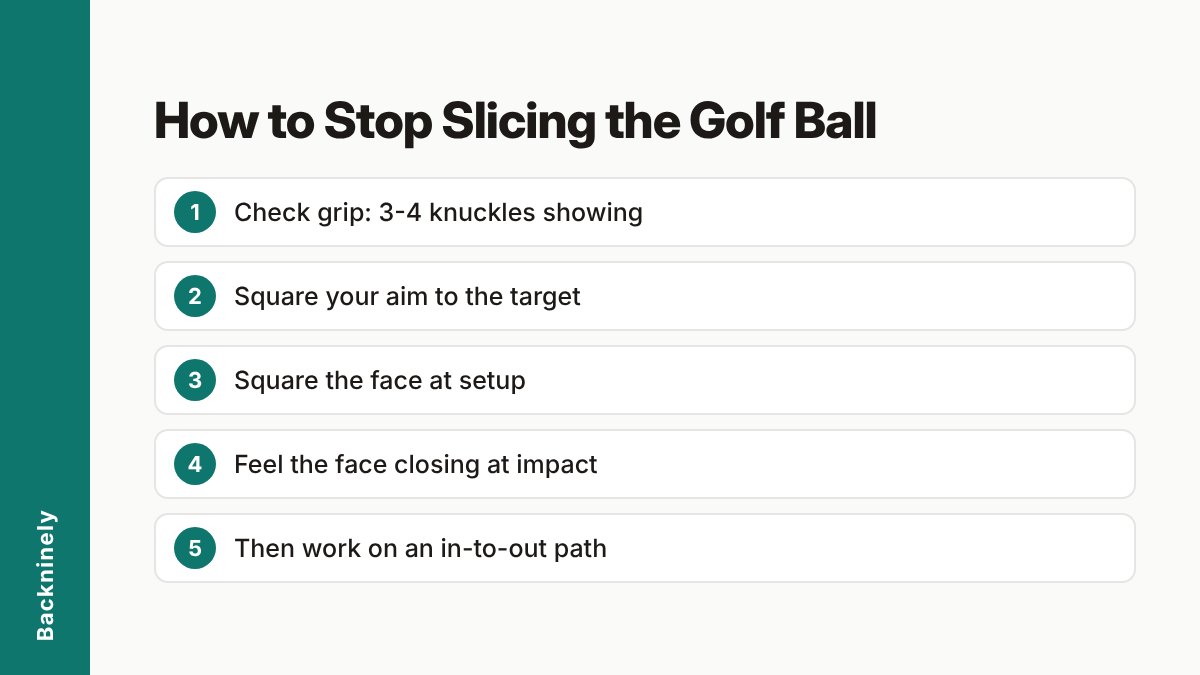
A slice is almost always a clubface that points to the right of your swing path (for a right-handed golfer) at impact. To stop it, check your grip and aim first, then train the face to close to the path with a few simple drills. The path can wait until the face is under control.
Quick answer
Fix these in order:
- Check your grip so the lead hand is closer to neutral or slightly strong.
- Check your aim so you are not aiming left to “make room” for the slice.
- Learn to feel the face closing through impact.
- Only then work on a more in-to-out path.
This order matters because the face has more influence on the shot than the path does. Instructors quoted by one golf publication put the face at roughly 75 to 85 percent of where the ball starts. Changing the path while the face stays open often just creates a new miss.
How a slice happens: face versus path
Two numbers shape every shot. The face angle (where the face points at impact) sets most of the starting direction. The face-to-path relationship (where the face points compared with where the club is traveling) sets the curve.
For a right-handed golfer:
- A face open to the path curves the ball right.
- A face closed to the path curves it left.
- A face square to the path produces a straight flight (relative to that path).
A slice is the first case: the face is open to the path. One published example describes a slicer with a face about 5 degrees right of target and a path about 2 degrees left, which leaves the face roughly 7 degrees open to the path. Many slicers then respond by aiming even further left, which swings the path more left and opens the face to the path even more.
Reading your miss
Use where the ball starts and where it ends up to work out the cause.
| What you see | Likely cause | Fix first |
|---|---|---|
| Starts right, curves right (push slice) | Face open to target and path | Square the face; check grip |
| Starts left, curves right (pull slice) | Face closed to target but open to path, often an over-the-top move | Fix the path |
| Starts straight, curves right | Face open to path by a modest amount | Small grip and release changes |
| Small curve | Mostly a path issue | Adjust the path |
| Large curve | Mostly an open face | Close the face |
One ball-flight reference notes that a small curve on a push slice points to a path problem, while a large curve points to an open face. That is a useful rule of thumb when you cannot measure anything.
What you need
- A club you hit often (a 7-iron is a good start, then the driver)
- Alignment sticks, or two spare clubs laid on the ground
- Ten to twenty range balls per drill
- Optional: a phone camera set up down the target line
Step-by-step fix
1. Check your grip
Look at your lead hand at address. A common check is to see about three or four knuckles on the lead hand, which sits closer to neutral than a weak grip with only one or two knuckles showing. If you see fewer, take the club out of your hand and rebuild the grip instead of just twisting your hand. A stronger grip makes it easier to close the face at impact without having to steer it during the swing.
2. Square the clubface at setup
Set the clubface behind the ball first, aimed where you want the ball to start, and build the grip around it. A face that is already pointing a little right of your intended line at address is a common source of slices. Some instructors even suggest a slightly closed face at setup for slicers, to discourage it from opening through impact. Try it with small adjustments and watch what the ball does.
3. Fix your aim
Lay one alignment stick along the target line and another parallel to it along your toes. Many slicers aim their feet and shoulders well left of the target. That setup encourages an out-to-in path and a face that stays open to it. Square your stance to the stick and aim your eyes to the right side of the target, so the ball starts right and has room to curve back.
4. Change the release
Instead of trying to square the face with a quick flip of the hands, focus on the follow-through. Feel the lead wrist bowing slightly and the trail wrist cupping so the club wraps around your body. Keeping your head and eyes steady through impact helps the club stay on the inside.
5. Then improve the path
Once the face is closer to square, move the path. Feel the clubhead staying outside your hands on the backswing and coming into the ball from slightly inside. Good players often swing a few degrees to the right of the target line with a face just right of target but closed to the path, which gives a gentle draw.
Three drills to groove it
| Drill | How to do it | What it trains |
|---|---|---|
| Headcover outside the ball | Place a headcover just outside and beyond the ball; swing without hitting it | In-to-out path |
| Half swings with a strong grip | Hit 20 half shots with the new grip | Face control |
| Pause at the top, then drop | Pause at the top and feel the club shallow behind you | Avoiding the over-the-top move |
Keep the swings smooth. Hard swings bring old habits back.
Common mistakes
- Aiming further left each time the ball slices. This increases the problem.
- Changing the path before the face is under control.
- Over-gripping the club. Tight hands make the release harder.
- Making a big grip change and then judging it after only a few shots. Give it a full range session.
- Chasing the driver first. The driver magnifies any face-to-path gap, so practice with a mid-iron before moving on.
When to get a lesson
If the ball still curves heavily after a few range sessions, a PGA or other qualified teaching professional can measure your face angle and path on a launch monitor and tell you which of the two to change first. Measuring takes the guesswork out, and you can bring your questions and the drills above.
Sources
Frequently asked questions
What causes a slice in golf?
A slice happens when the clubface is open relative to your swing path at impact. That gap puts sidespin on the ball and curves it right for a right-handed golfer.
Is a slice caused by the swing path or the clubface?
Both matter, but the clubface does most of the work. It controls most of the starting direction, and its angle to the path sets the curve, so squaring the face usually comes first.
Will a stronger grip fix my slice?
For many golfers it helps, because a stronger grip makes it easier to square the face at impact without a last-second fix. Make the change in small steps and check it on the range.
Why do I slice my driver more than my irons?
The driver has less loft, so the same face-to-path gap produces more sidespin. The ball also stays in the air longer, so the curve has more time to grow.